The Med Spa SOP Binder: Policies Every RN Injector Should Understand (Even as an Employee) Continued
Confidence comes from patterns, not guessing. This post shows what to track and why (without revealing your full tracker sheets).
Kimberly Thompson, RN
5/5/20268 min read
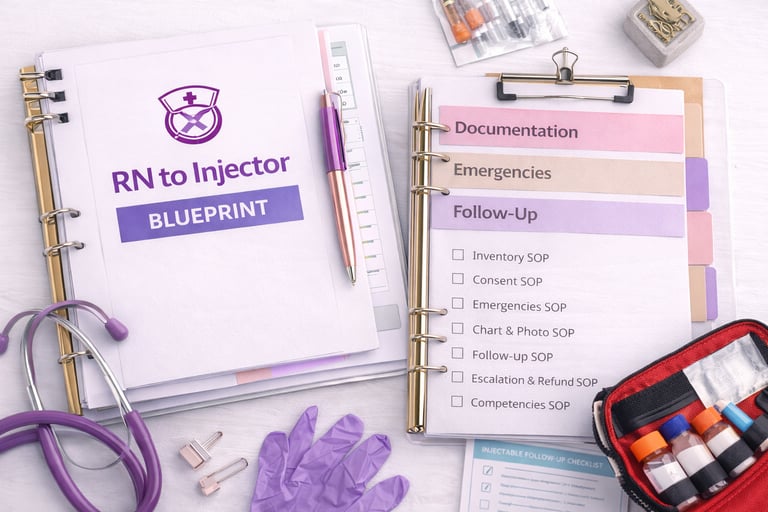
The Med Spa SOP Binder: Policies Every RN Injector Should Understand (Even as an Employee)
If you’re an RN injector (or becoming one), one of the biggest career traps is assuming “the clinic handles the policies.”
Because when something goes wrong—an upset patient, a chart audit, a complication concern, a product question, a photo consent issue—the policies are what protect you.
Not vibes.
Not “how we usually do it.”
Not “the owner said it’s fine.”
Policies and SOPs are the difference between a clinic that runs safely and a clinic that runs on memory.
This guide breaks down the Med Spa SOP Binder: what it is, what it should include, and what you (as an RN employee) should understand before you inject, chart, or even post content.
Educational content only. Rules vary by state and setting. Verify scope, supervision, and documentation standards with your employer, medical director, and appropriate licensing boards.
Table of Contents
What is an SOP binder (and why it matters for RN injectors)?
The “non-negotiable” SOP categories in a safe med spa
Documentation SOPs (the #1 license protection policy)
Consent + photo SOPs (what clinics often do wrong)
Patient selection + contraindication SOPs
Aftercare + follow-up SOPs (where complaints are prevented)
Complication readiness SOPs (your plan before you need it)
Product handling SOPs (inventory, storage, lot numbers, authenticity)
Communication SOPs (texts, DMs, phone calls, and what not to say)
Complaints + refund SOPs (how clinics avoid escalation)
Training + competency SOPs (what “ready” should mean)
A “Know Your Policies” checklist for RN injectors
Free resources + next step (Blueprint)
What is an SOP binder (and why it matters for RN injectors)?
SOP stands for Standard Operating Procedure: a written protocol that documents the exact steps to follow for repeatable clinic tasks—especially the ones that involve risk, safety, documentation, or legal exposure.
In a med spa, SOPs reduce:
confusion
inconsistent patient experiences
“he said/she said” situations
documentation gaps
response delays during adverse events
For RN injectors, SOPs also reduce personal risk because they clarify:
what you’re expected to do
what is considered “standard” in your clinic
who you contact when something escalates
how you document decisions and patient education
Why employees need SOPs too
Some RNs think: “I’m not the owner, so I don’t need to worry about all that.”
But as an RN, your license is still yours. The board does not accept “my boss told me it was fine” as a defense when:
protocols were missing
documentation was inconsistent
consent was vague
supervision structure was unclear
adverse event response wasn’t organized
That’s why the safest injectors are the ones who understand the binder—even as employees.
The “non-negotiable” SOP categories in a safe med spa
A strong SOP binder usually includes these categories:
Documentation & Charting SOPs
Informed Consent + Photo Consent SOPs
Patient Selection + Contraindications SOPs
Aftercare + Follow-Up SOPs
Complication Readiness / Adverse Event SOPs
Medication/Product Handling SOPs
Communication SOPs (texts, calls, DMs)
Complaint, Refund, and Escalation SOPs
Training + Competency SOPs
Quality Assurance SOPs (chart review, audits, protocol updates)
Many clinics have some of these. Fewer clinics have all of them written clearly.
And the clinics that don’t have them tend to operate in chaos—until a problem forces them to “suddenly care.”
Documentation SOPs: the #1 policy that protects your license
If your med spa SOP binder is missing or weak in one area, it’s usually documentation.
Because in aesthetics, a high percentage of issues aren’t about the injection itself—they’re about:
unclear expectations
incomplete documentation
unclear follow-up instructions
lack of recorded education on risks/alternatives
missing consent or photo handling records
What a documentation SOP should define
At a minimum, the binder should clarify:
A) What must be documented at every visit
intake/medical history update process (and frequency)
assessment notes (what you evaluated)
treatment plan rationale (why that option)
what was discussed (education + expectations)
what was performed (service details, product identifiers)
aftercare provided + confirmed understanding
follow-up instructions and red flag symptoms
B) Where and how documentation is stored
EMR vs paper storage
photo storage process
who has access and permissions
retention policies (varies by state and clinic)
C) What happens when documentation is incomplete
how it’s corrected
who reviews it
when it must be corrected by
what counts as “late entry” documentation in that clinic
Why this matters (facts)
Informed consent and documentation failures show up in patient complaints and negligence claims research. Studies analyzing medical negligence claims and patient complaints have identified informed consent problems as a recurring theme when disputes occur.
Separately, clinical ethics and risk management literature emphasizes that properly obtaining informed consent supports patient autonomy and trust and can reduce risk.
Translation: In a complaint, your chart and consent records are often your strongest evidence of what was discussed and why decisions were made.
Case Study #1 (Realistic Scenario): “The Touch-Up Dispute”
Note: This is a fictional case study based on common patterns seen in clinic disputes.
Stacey is an RN injector working in a busy med spa.
A patient returns upset that her filler result “doesn’t match what she expected,” demanding a refund and threatening to post on social media.
The clinic owner asks Stacey:
“Did you document that you discussed realistic outcomes and variability?”
Stacey documented product and areas—but not:
the patient’s stated goals
what Stacey educated about realistic outcomes
that alternative options were discussed
that a follow-up timeline was offered
Now Stacey is stuck defending a conversation that isn’t clearly captured in the chart.
SOP lesson
A documentation SOP prevents this by giving a consistent structure:
goal → assessment → plan rationale → education → aftercare → follow-up plan
And the clinic should have a complaint/refund SOP (we’ll cover that below) so the RN isn’t left “negotiating” emotionally.
Informed consent + photo consent SOPs (where clinics often mess up)
Many med spas treat consent like a signature page.
But informed consent is a process, not a checkbox. Risk-management literature has long emphasized that effective informed consent supports patient autonomy and trust and reduces risk when done correctly.
Consent SOPs should define:
when consent is obtained (timing)
who explains risks/alternatives
how questions are handled
how consent is documented
how long consent is valid (policy varies)
what triggers a new consent (new treatment, new risk profile, etc.)
Photo consent SOPs should define:
how photos are taken (lighting/angles consistency)
where photos are stored
who can access them
what “marketing use” consent requires
how to handle revocation of consent
how to handle patient requests for deletion/withdrawal
Why employees should care:
If you take photos, store them, or post them—even indirectly—photo consent rules matter.
Patient selection + contraindications SOPs
Patient selection is one of the most important safety systems in aesthetics.
A good SOP binder clearly defines:
required screening questions
contraindications
when to defer treatment
when to require provider clearance
how to document decision-making
What “patient selection SOPs” look like in practice
They often include:
intake form standards
medication review prompts
pregnancy/breastfeeding policy
blood thinner policy
history of adverse reactions
infection/skin integrity standards
recent procedures and timing considerations
“red flag” symptoms that require deferment
Info gap (intentional):
The exact screening workflows, documentation prompts, and “defer scripts” are where most clinics are inconsistent—and those are exactly the tools that belong in a structured program like the Blueprint.
Aftercare + follow-up SOPs (where complaints are prevented)
A surprising number of disputes happen after treatment because the patient:
didn’t understand what was normal
didn’t know what symptoms were urgent
wasn’t given a clear follow-up plan
wasn’t sure who to contact
Your binder should include:
standard aftercare instructions by service type
red flag symptoms and escalation instructions
after-hours contact process
follow-up timelines (what’s normal and when to reassess)
documentation standards for follow-up interactions
Case Study #2: “The Weekend Panic Text”
Fictional scenario based on common med spa workflow gaps.
A patient texts the clinic line on a Saturday:
“I’m swelling and I’m freaking out.”
The RN on call asks:
Which number do they text?
Who is responsible for responding?
What symptoms require escalation?
What gets documented and where?
If there is no SOP, responses become inconsistent:
delayed replies
mixed messaging
missing documentation of what was advised
This is where a follow-up SOP protects both patient and RN.
Complication readiness SOPs: your plan before you need it
Every injector should know this truth:
You don’t rise to the level of your training.
You fall to the level of your systems.
Complications are rare, but they are real. In dermal filler literature, intravascular occlusion is considered very low risk overall, but still a serious adverse event requiring prompt recognition and management.
And evidence-based recommendations exist for prevention and management strategies, including how vascular occlusion events are approached.
What a complication readiness SOP should define (high level)
Without getting into clinical instruction, a safe SOP binder includes:
“what to do first” escalation flow (who to contact, where to document)
emergency supply location and inventory responsibility
roles during escalation (who calls, who documents, who communicates)
patient communication standards (what NOT to promise)
documentation expectations during adverse events
follow-up timeline documentation requirements
Intentional gap:
The “step-by-step checklist pages” and escalation scripts are what most nurses want most—and that’s exactly why those are valuable inside the RN to Injector Blueprint (not scattered online).
Product handling SOPs (inventory, storage, lot numbers, authenticity)
This is a silent risk area.
Product handling SOPs should define:
where products are stored and temperature requirements
inventory receiving and verification workflow
lot number documentation requirements
expiration tracking
“what to do if product integrity is questioned”
policies to prevent gray-market purchasing
Even as an employee, you should know:
how your clinic verifies product authenticity
where lot numbers are recorded
what documentation is required in the chart
Communication SOPs (texts, DMs, phone calls—and what not to say)
Aesthetics creates modern communication problems:
patients DM before they book
they text photos of swelling
they ask “is this normal?” at 10pm
they request refunds through Instagram
A communication SOP should define:
what channel is allowed for clinical communication
how PHI is handled (high-level)
who can respond (and when)
what gets documented
after-hours boundaries and escalation rules
Pro tip for clinics:
If the only communication system is a staff member’s personal phone, that’s a red flag for policy gaps.
Complaints + refund SOPs (how clinics avoid escalation)
If your clinic doesn’t have a complaint SOP, the RN becomes the emotional shock absorber.
A complaint SOP should include:
who responds to complaints (and when)
how complaints are documented
what language to use (and what not to say)
when to bring in the medical director/owner
refund policy structure
follow-up and resolution workflow
Case Study #3: “The Google Review Threat”
Fictional scenario based on common patterns.
A patient threatens:
“If you don’t refund me, I’m leaving a 1-star review and reporting you.”
Without a policy, staff may:
offer inconsistent refunds
overpromise outcomes
panic-text the patient
forget to document interactions
With a policy, the clinic stays calm, consistent, and professional.
Training + competency SOPs (what “ready” should mean)
Some clinics throw new injectors into treating too early.
A training SOP should define:
what training is required before treating
what observation and supervised repetition is expected
what competencies are evaluated
what ongoing education is required
how new services are added safely
This protects:
patients
clinic reputation
RN confidence
overall compliance structure
“Know Your Policies” checklist for RN injectors" (print this)
Use this checklist as an employee:
Documentation
I know the required note structure for each service.
I know where lot numbers and consent are recorded.
I know how photos are stored and who has access.
Consent & photos
I know the clinic’s consent workflow and renewal rules.
I know photo consent rules for marketing use.
Follow-up & escalation
I know who to contact for urgent concerns.
I know after-hours rules and what gets documented.
Complication readiness
I know where emergency supplies are stored.
I know the clinic escalation workflow and roles.
Product handling
I know product receiving/storage rules.
I know how authenticity and expiration are tracked.
Complaints
I know the complaint workflow and refund policy.
I know who responds and how it’s documented.
If you can’t confidently check these, it’s not a personal failure—it’s a systems gap.
Free resources + next step (links included)
If you’re not ready to buy anything yet, start with the free guide so you can make smarter next steps:
✅ Get the free Quick Start Guide:
https://nurseguided.systeme.io/freebie
If you want the full “done-for-you” toolkit (SOP binder table of contents, checklists, documentation prompts, scripts, and step-by-step structure), that’s exactly what’s inside the Blueprint:
✅ Get the RN to Injector Blueprint:
https://www.nurseguided.com/blueprint
And if you’re building the business side too, check your calculator tools here:
✅ Med Spa Calculators:
https://www.nurseguided.com/med-spa-calculators
More resources and training hubs:
https://www.nurseguided.com
References (factual support)
Murphy JB. Benefits and Challenges of Informed Consent. Mayo Clinic Proceedings (2008).
Gogos AJ, et al. When informed consent goes poorly: a descriptive study of medical negligence claims and patient complaints. Med J Aust (2011).
Jones DH, et al. Preventing and Treating Adverse Events of Injectable Fillers: Evidence-Based Recommendations From the ASDS Multidisciplinary Task Force (2021).
Alam M, et al. Rates of Vascular Occlusion Associated With Using Needles vs Cannulas for Dermal Filler Injections. JAMA Dermatology (2021)
Nurse Guided
Newsletter: Get weekly tips for nurses entering aesthetics.
rn@nurseguided.com
Empowering nurses with practical tools for aesthetic career growth and med spa startup planning.
Resources
Articles
Company
Legal
© 2026 NurseGuided. All rights reserved. | Created by Kimberly Thompson, RN
Educational content only. Not legal, medical, financial, or regulatory advice.